Are You Buying Health, or Just a Marketing Story?
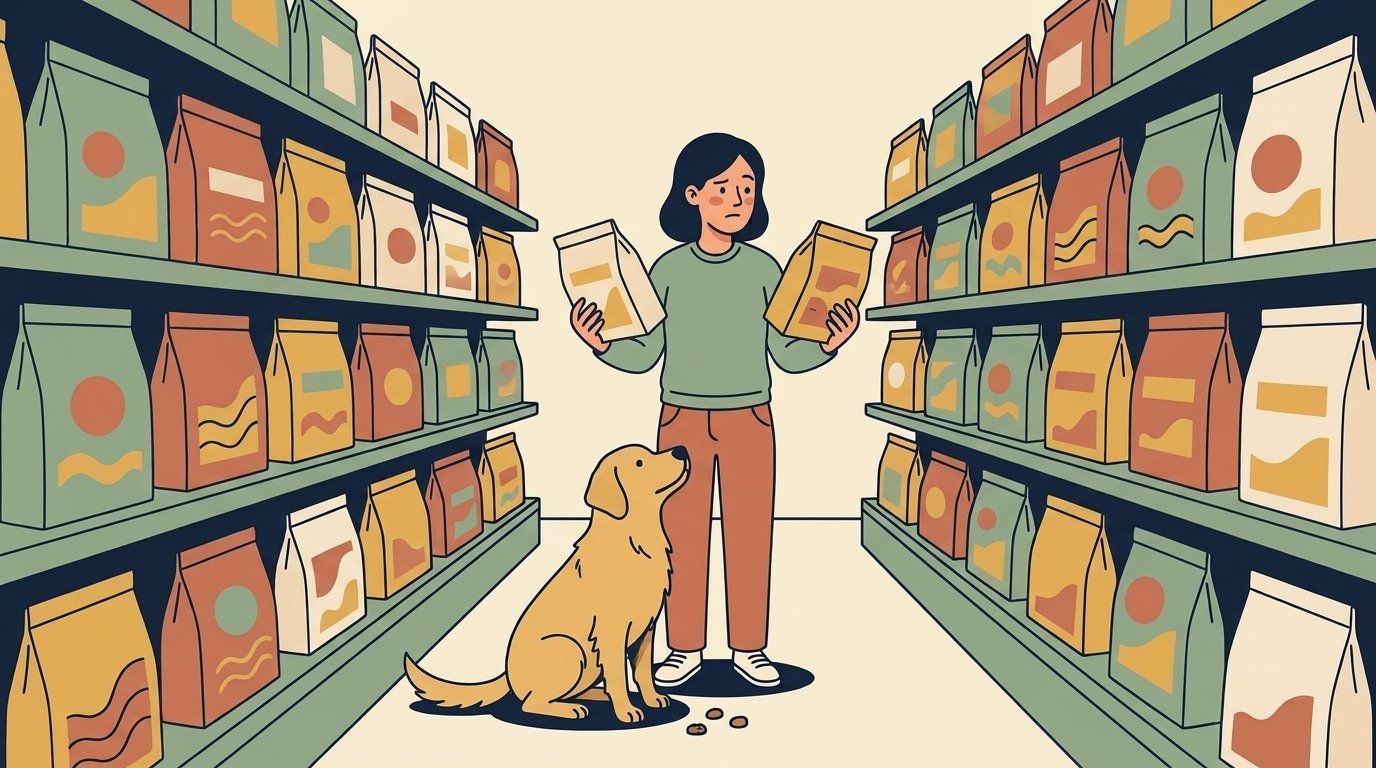
Picture a Saturday afternoon in the dog food aisle at Petco or PetSmart. This is where knowing how to read a dog food label pays off.
On the left: a bag showing thick-cut chicken and glossy green vegetables. On the right: kraft-paper packaging with “Natural” and “Grain-Free” stamped across the front like a badge of honor. One more bag down, and the dog on the label looks like he just trotted out of a mountain meadow.
You start to spiral. Is the pricey one better? Is “natural” actually natural? Is the bag your favorite influencer swears by even decent?
Here’s what nobody prints on the front: pet food marketing is slick, expensive, and built to make you feel something. Those fresh-cut chicken breasts and farm-stand vegetables came from a designer, not a nutritionist. The front of the bag is advertising. It isn’t a nutrition report.
This guide on how to read a dog food label teaches one skill: flip the bag over and peel off the marketing, layer by layer. We’ll go from the AAFCO statement to the ingredient-order tricks: no brand names, no hype.
One note before we start: If your dog is itchy, has loose stools, or just isn’t acting right, food may be involved, or it may not. Your vet makes that call.
Table of Contents
What is AAFCO and Why Should Dog Parents Care?
AAFCO stands for the Association of American Feed Control Officials. It sounds like a government agency, and plenty of people assume it is.
It isn’t. AAFCO is a nonprofit that sets standards for animal feed and pet food in the U.S., and its members include state and federal feed regulators. It does two main things:
- It sets nutrient profiles: the nutrient levels a complete dog food is expected to meet for a given life stage.
- It publishes model regulations for labeling and ingredient definitions, which most states then adopt into their own laws.
What it doesn’t do: test, approve, or certify any individual product. State feed officials and the FDA handle enforcement.
So when a bag says “AAFCO Certified” or “AAFCO Approved,” don’t be impressed. There is no such certification. A brand can legitimately claim that its food meets AAFCO’s standards through one of the recognized methods, and that claim lives in a small block of text on the back.
The Fine Print That Matters Most
Turn the bag over and find the Nutritional Adequacy Statement. It’s usually in small print on the back or side. You’re looking for “Complete and Balanced.” AAFCO uses “complete” to mean all required nutrients are present and “balanced” to mean they’re in the right ratios.
- You see it: the food is designed to be a dog’s main diet.
- You don’t: it may be a treat, topper, or supplement. Some labels say it’s for intermittent or supplemental feeding only. Don’t serve that as the main course. (Some veterinary therapeutic diets use this wording too, and you use those under your vet’s direction.)
Next, check the life stage: gestation/lactation, growth, maintenance, or all life stages.
- A food for all life stages has to meet the more demanding growth-and-reproduction needs. Those formulas run higher in protein and fat and are often more calorie-dense, so watch portions for less active adult dogs.
- Puppies expected to weigh 70 pounds or more as adults need tighter calcium control. For growth or all-life-stages foods, the label must state whether the food includes or excludes growth for large-breed dogs. If you have a large-breed puppy, look for “including.”
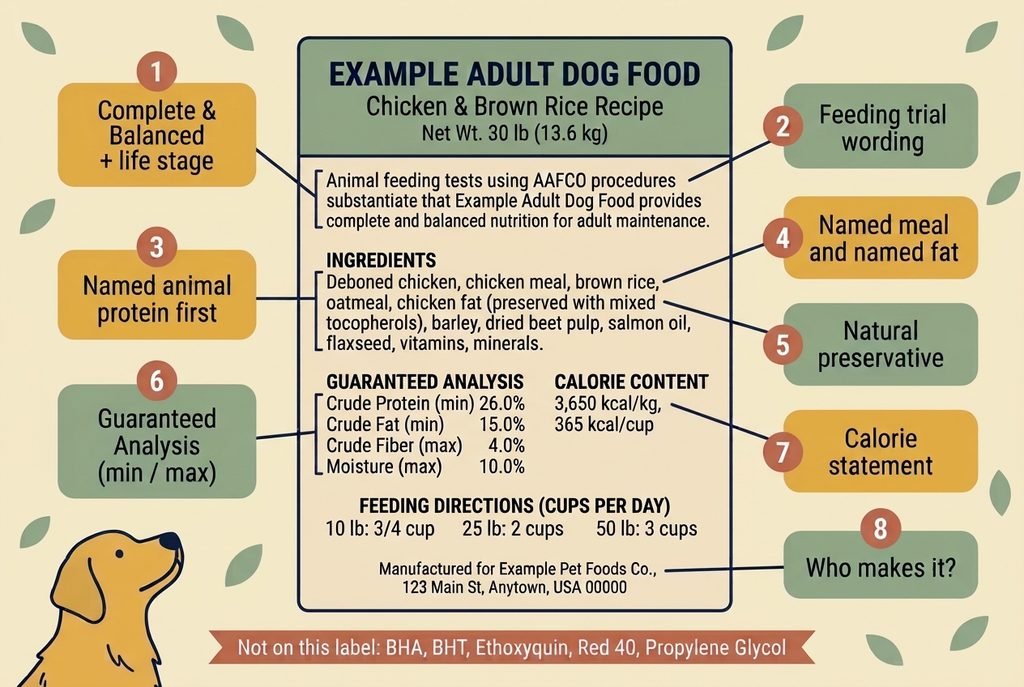
- Complete and Balanced + life stage: the nutritional adequacy statement. It tells you the food is meant to be a main diet.
- Feeding trial wording: “animal feeding tests” means real dogs ate the food. Formulated-only foods use different wording.
- Named animal protein first: chicken, not “meat.”
- Named meal and named fat: chicken meal and chicken fat, not “meat meal” or “animal fat.”
- Natural preservative: mixed tocopherols instead of BHA, BHT, or ethoxyquin.
- Guaranteed Analysis: minimums for protein and fat, maximums for fiber and moisture. Convert to a dry matter basis before comparing foods.
- Calorie statement: kcal per kilogram and per cup.
- Who makes it?: the manufacturer’s name and address.
Two Paths to “Complete and Balanced”
AAFCO recognizes three ways to back up the claim. Two matter most.
Path 1: Formulated. The label says the food is “formulated to meet” AAFCO’s nutrient profiles for a life stage. Translation: the recipe hits the numbers on paper, either calculated from ingredient data or confirmed by lab analysis of the finished food. No dogs ate it as part of the claim.
Path 2: Feeding trial. The label says “animal feeding tests using AAFCO procedures” support the claim. Translation: real dogs ate it as their only food. For adult maintenance, the standard protocol looks like this:
- At least 8 healthy adult dogs start, and at least 6 must finish.
- The test runs 26 weeks (about six months)
- Dogs are weighed weekly and examined by a vet at the start and end.
- Vets check four blood values at the end: hemoglobin, packed cell volume, albumin, and alkaline phosphatase.
Why do many vets treat a trial as extra evidence? Because numbers on paper aren’t the same as nutrients a dog actually absorbs. A trial at least shows real dogs doing fine on the food for six months.
Now the fair part. AAFCO treats all three methods as valid ways to substantiate the claim, and trials have limits. Eight dogs for six months can miss problems that develop slowly, and four blood values are a narrow check. A feeding trial is a point in a food’s favor, not a guarantee. A formulated food isn’t “bad” either. It just comes with one less layer of evidence, so ask the company how it verified the finished product.
There’s also a rarely used third statement: the food is “comparable” to a similar product that passed a feeding trial. That’s the “family product” route. The food in your bag wasn’t the one tested.
The “Rule of Weight”: How Dog Food Ingredients Are Ordered
In the U.S., ingredients must be listed in descending order by weight. Key detail: those weights include water, so a moisture-heavy ingredient can rank higher than a dry ingredient that contributes more nutrition.
That sounds fair. It also leaves plenty of room for a label to look different from the actual recipe.
Ingredient Splitting: The Legal Shell Game
Here’s a hypothetical ingredient list:
Chicken, Ground Corn, Chicken Meal, Corn Gluten Meal, Beet Pulp, Corn Flour, …
Chicken is first. Looks great. Now suppose (made-up numbers) the chicken is 20% of the recipe and each corn ingredient is 12%.
- On their own, each corn ingredient weighs less than the chicken, so they sit lower on the list.
- Added together, the corn-derived ingredients make up 36%, well ahead of the chicken.
That’s ingredient splitting: one grain broken into several names, so each piece lands lower on the list. Real labels don’t show percentages, so you can’t know the exact split. You can, however, spot the pattern.
Water adds a second twist. Fresh chicken is roughly 70% water. Once it’s cooked and dried into kibble, much of that weight is gone. “Chicken” in the first slot can shrink a lot by the time it hits the bowl.
Put the two together, and a label can look meat-first while the dry food leans more heavily on grain-derived ingredients.
How to check it yourself:
- If the same ingredient family shows up under three or more names, stop and mentally combine them.
- Peas play the same game: Peas, Pea Protein, Pea Starch, Pea Fiber. Count them together
In fairness: corn isn’t poison. It’s an energy and fiber source. The issue is how the label can make the recipe look more meat-heavy than it is. And grain-free doesn’t automatically mean healthier. The FDA looked into reports of dilated cardiomyopathy (DCM) in dogs eating certain diets, many labeled grain-free and built around peas, lentils, other legumes, or potatoes. The agency says those reports alone can’t establish cause and effect, and as of its last public update in December 2022, the question hadn’t been settled. (DCM also runs in families of certain breeds.) The takeaway: judge the whole recipe, not one buzzword.
Demystifying “Meal” vs. “By-Products”: What’s Actually Inside?
Meal: A Misunderstood Protein Source
Many owners see Chicken Meal and assume it’s scraps. It isn’t. Meal is cooked, dried, and ground meat. The water is gone, and the protein is concentrated.
The typical numbers:
- Fresh chicken: about 70% water and roughly 18% protein
- Chicken meal: about 10% water and roughly 65% protein
So chicken meal in the second slot can deliver as much protein as fresh chicken in the first slot, or more. Neither is “better.” They’re just different forms.
The label rule that matters is naming the species:
- Good: Chicken Meal, Beef Meal, Lamb Meal, Salmon Meal
- Less informative: Meat Meal and Meat and Bone Meal (AAFCO lets these come from mammals without naming which), and Animal By-Product Meal.
Quality still varies with the supplier and how the meal was processed. A named meal is a good sign, not a guarantee.
By-Products: Read the Definition Before You React
Wild canids typically eat organs along with muscle. Organ meats like liver and kidney are rich in vitamin A, B vitamins, iron, and copper.
AAFCO defines by-products as secondary products made alongside the main product and states they can be safely used for nutrition. Under AAFCO’s ingredient definitions:
- Meat by-products are the clean, non-muscle parts of slaughtered mammals, such as lungs, spleen, kidneys, liver, blood, bone, and emptied stomachs and intestines. They do not include hair, horns, teeth, or hooves.
- Poultry by-products are clean parts such as heads, feet, and viscera. Poultry by-product meal excludes feathers except in trace amounts.
So the word “by-product” alone isn’t a quality verdict.
What you should avoid is vague labeling:
- Meat By-Products: AAFCO lets labelers use the generic word “meat” only for cattle, pigs, sheep, or goats, and other species must be named. You know the pool but not the animal, and the source can change from batch to batch.
- Animal Fat: it can come from any animal source
- Animal Digest: no species given
- Meat Meal, Meat and Bone Meal, Animal By-Product Meal: no species given
The more specific, the better. Chicken Fat beats Animal Fat. Chicken By-Product Meal is more informative than Poultry By-Product Meal.
There’s a practical reason to care too. If your dog has chronic itching or recurring ear problems, your vet may suggest an elimination diet, which is the reference standard for diagnosing food allergy. In dogs, the most commonly reported food allergens are beef, dairy, chicken, wheat, and lamb. Vague ingredient names make that detective work harder. For a plain-English rundown of common symptoms and what to watch for, see Dog Food Allergy Symptoms: 2 Easy Recipes & 7-Day Guide.
Red Flags to Avoid on Dog Food Labels
Screenshot this list for your next store trip. First, the logic: most of these ingredients are legal within set limits, and legal doesn’t mean ideal. If a better alternative exists, there’s little reason to pick the debated option.
Red Flag 1: Chemical Preservatives
- BHA (Butylated Hydroxyanisole)
- BHT (Butylated Hydroxytoluene)
- Ethoxyquin
These are synthetic antioxidants that keep fats from going rancid. All three are allowed in pet food within limits. The concern comes from a few places:
- The U.S. National Toxicology Program lists BHA as “reasonably anticipated to be a human carcinogen” based on animal studies. Human data are considered inadequate.
- The FDA allows up to 150 ppm of ethoxyquin in pet food and, in 1997, asked dog food makers to voluntarily cut it to 75 ppm for an added safety margin, especially for nursing mothers and puppies. Owners have reported health problems over the years, while a former FDA staffer writing in an industry publication says the agency couldn’t find a scientific basis for those reports.
So the evidence of harm at pet food levels is limited and debated. Because natural alternatives exist, I treat these as a precaution, not a proven danger.
Look for these instead: Mixed Tocopherols (a form of vitamin E), Ascorbic Acid (vitamin C), or Rosemary Extract.
Two useful tips:
- Natural preservatives don’t last as long, so check the Best By date and lean toward smaller bags.
- Ingredients like fish meal can arrive at the plant already preserved. If that worries you, ask the company directly whether they preserved any ingredients with ethoxyquin.
Red Flag 2: Artificial Colors and Flavors
- Red 40, Yellow 5, Yellow 6, Blue 2
- Artificial Flavor
Dogs don’t see in black and white, but they have dichromatic vision. They see blues and yellows best and struggle to tell red from green. Those red and green kibble bits are likely a muted blur to your dog. The color is there to please you, not your dog. Color additives have to be FDA-approved for pet food, so they’re legal. They’re also unnecessary.
Some people suspect dyes may trigger reactions in sensitive dogs, but research is limited. When dogs do have a true food allergy, the usual triggers are proteins such as beef, dairy, chicken, wheat, or lamb. Whether symptoms are diet-related is a question for your vet. For more on common signs, see Dog Food Allergy Symptoms: 2 Easy Recipes & 7-Day Guide.
Red Flag 3: The Humectant Propylene Glycol
Propylene Glycol is common in semi-moist foods and some treats. It keeps them soft.
Don’t confuse it with Ethylene Glycol. That’s automotive antifreeze, and it’s highly toxic. They’re different chemicals. Propylene glycol is permitted in dog food, but AAFCO notes it’s unsafe for cats and prohibited in cat food. If you have cats at home, keep them away from dog treats that contain it.
Even where it’s legal, it’s an unnecessary chemical additive for a clean-label shopper.
Bonus Red Flags
- Vague ingredients: Meat By-Products, Animal Fat, Animal Digest
- Sweeteners high on the list: Corn Syrup, Sugar
- One ingredient split into several names (see the splitting section above)
One red flag doesn’t make a food toxic—my personal rule: synthetic preservatives plus vague ingredients go back on the shelf.
Best Clean-Label Dog Food: How to Choose Wisely Without the Advertising Hype
“Clean label” has no legal definition. Any company can print it. Even “natural” has a narrow meaning: AAFCO’s definition focuses on ingredient sources and synthetic additives, and it makes no promise about safety or nutritional quality. So you need your own yardstick. Here are four points. No brands, just method.
Point 1: The 5-Ingredient Rule
AAFCO calls the first few ingredients the “major” ingredients. The top five give you a useful snapshot of the recipe, though without percentages it’s a rough guide.
- The top 2 to 3 should be named animal proteins (Chicken, Beef, Salmon, Chicken Meal)
- Be cautious if the top five are crowded with several corn, wheat, or pea fractions or vague ingredients.
- A high protein percentage doesn’t always mean animal protein. Ingredients like Pea Protein and Potato Protein can raise the number too.
Point 2: Go Beyond AAFCO with WSAVA Guidelines
Meeting AAFCO is the baseline. The World Small Animal Veterinary Association (WSAVA) publishes guidelines on selecting pet foods. WSAVA doesn’t approve brands. It gives you questions to ask:
- Does the company employ a qualified nutritionist? That means a PhD in animal nutrition or a board-certified veterinary nutritionist (in the U.S., DACVIM (Nutrition), formerly ACVN; in Europe, ECVCN). Ask for the name, credentials, and employment status, since outside consultants may have less influence than staff.
- Who formulates the diet?
- What quality control is in place for ingredients and finished products?
- Has the company done any product research, ideally published?
- Is the food labeled complete and balanced, and by feeding trial or formulation?
- Can the company give you calories and a typical nutrient analysis?
- Who makes the food: the company’s own plant or a third-party manufacturer (look for “Made for” or “Distributed by”)? Outsourcing isn’t automatically bad, so ask how they check quality.
Check the website first. If you can’t find answers, email customer service. Fast, specific answers signal transparency. Corporate dodging is a warning sign. WSAVA itself encourages caution if a manufacturer can’t or won’t provide this information.
One caveat: employing a nutritionist doesn’t prove that person formulated this particular recipe, which is why “who formulates?” is on the list. Some industry commentators also point out that WSAVA’s nutrition committee is supported in part by large pet food manufacturers. Treat the guidelines as a screening tool, not a seal of approval.
Point 3: Traceability
- Batch testing: companies aren’t required to publish it, so a brand that shares results for heavy metals, pathogens, and mold toxins is showing real transparency
- Ingredient origin: can they tell you which countries and suppliers their ingredients come from, beyond “premium ingredients”?
- Recall history: before you buy, check the brand on the FDA’s Animal & Veterinary Recalls & Withdrawals page, which covers pet food
Why it matters: in 2007, a huge U.S. pet food recall traced back to wheat gluten and rice protein concentrate imported from China that was contaminated with melamine. Protein numbers on labels come from a nitrogen test, which is why melamine can make protein look higher than it really is. The lesson: when you can’t see the supply chain, you can’t see the risk.
Point 4: Processing Transparency
Heavy processing can reduce the value of good ingredients. Look for a clear description of how the food is made:
- Baked
- Air-dried
- Freeze-dried
- Gently cooked
Gentler cooking may preserve more of some heat-sensitive nutrients, but evidence comparing processing methods in dogs is limited. Don’t assume kibble is bad or that freeze-dried is automatically better. And don’t go too far on supplements either: most Complete and Balanced foods use added vitamin and mineral premixes, and that’s normal. What matters is what’s added and who’s checking the balance.
One safety note. The CDC lists raw, raw frozen, freeze-dried, and dehydrated products in its raw pet food category. It does not recommend feeding raw pet food because it can contain germs, including Salmonella and Listeria. Homes with young children, older adults, pregnant people, or anyone with a weakened immune system face a higher risk. If you choose a raw product anyway, ask the company how it kills germs, and follow safe-handling steps.
The Ultimate Dog Food Label Hacker’s Checklist
Screenshot this and take it to the store. Give each food 60 seconds.
| Check | Pass | Fail | Straight-talk take |
|---|---|---|---|
| AAFCO statement | “Complete and balanced” plus a life stage (and “including” large-size dogs for large-breed puppies) | No statement on a food sold as a main meal, or an “AAFCO Certified” claim | “Certified” is the tell. AAFCO doesn’t certify anything. |
| How it was validated | Feeding trial, or formulated and the company shares finished-product analysis | Formulated only, and the company won’t share anything else | A trial is a plus, not a guarantee. |
| First ingredient | Named animal protein (Chicken, Beef, Chicken Meal) | A grain or an unnamed meat source first | Line one tells you a lot, never everything. |
| Ingredient splitting | Related ingredients appear once or twice | Corn, wheat, or pea fractions under three or more names | Same corn, different outfits. |
| Meals and by-products | Species named (Chicken Meal, Lamb Meal, Chicken By-Product Meal) | Meat By-Products, Meat and Bone Meal, Animal Digest, Animal By-Product Meal | No name, no traceability. |
| Fat source | Chicken Fat, Salmon Oil | Animal Fat | “Animal” is a category, not a source. |
| Preservatives | Mixed Tocopherols, Rosemary Extract, Ascorbic Acid | BHA, BHT, Ethoxyquin | Natural options exist. Why pick the debated one? |
| Colors, flavors, humectants | None | Red 40, Yellow 5, Artificial Flavor, Propylene Glycol | Your dog can’t tell. Your eyes are the target. |
| Nutrition team | A qualified nutritionist, and the company will say who formulates | Can’t or won’t say | Who wrote the recipe? If nobody will tell you, shop elsewhere. |
| Transparency | Shares testing results and ingredient origins; recall history is easy to check | “We use quality ingredients” and nothing more | “Quality” is an adjective. A test report is evidence. |
| Processing | Clear description of the cooking method and safety steps | Only vague wording like “natural” | “Natural” says little about nutrition or processing. |
| The numbers | Calorie statement; foods compared on a dry matter basis | Comparing “high protein” claims across wet and dry foods | Wet food is mostly water. Do the math first. |
How to score it (my rule of thumb, not a scientific scale):
- 0 to 1 Fails: put it on the shortlist
- 2 or more Fails: back on the shelf
Switching foods: transition gradually over about 7 to 10 days, slowly increasing the new food’s share and reducing the old. Dogs with sensitive stomachs may need longer. If loose stools or itching show up during a switch, it may be the new recipe, the pace of the change, or something unrelated, so call your vet if it doesn’t settle. If your dog has a medical condition such as allergies, kidney disease, or pancreatitis, talk to your vet before changing foods.
Too busy to check every item yourself? Snap photos of the ingredient list and nutrition label and send them to PetScan — Find Out What’s Really in Your Dog’s Food. You upload the label and get an ingredient breakdown and alternative food suggestions (paid service). It’s a label-review tool, not an allergy diagnosis, and it doesn’t replace your vet.
Conclusion: Stop Buying the Front Cover, Start Reading the Back
Next time you buy dog food, or scroll past another influencer recommendation, do one thing: flip the bag over.
The happy dogs and fresh vegetables on the front are a fairy tale marketers wrote. What actually tells you what your dog is eating is on the back:
- The AAFCO statement: is it complete and balanced, and how was that shown?
- The first five ingredients: who’s on top, and is anything split?
- The team and the transparency: who wrote the recipe, and will the company show its testing?
None of that shows up in an ad. Take your buying power back from the pet food industry’s ad budget and put it in the hands of someone who can read a label.
One last reminder: no single food is right for every dog. If your dog has allergy concerns, kidney or pancreatic disease, or is a puppy or a senior, talk to your vet before changing foods. A label can cut through most of the noise. Your vet handles the rest. This article is educational and isn’t a substitute for veterinary advice.
How to Read a Dog Food Label: Frequently Asked Questions
Is “AAFCO Certified” dog food real?
No. AAFCO sets nutrient profiles and model labeling rules, but it doesn’t test, approve, or certify individual pet foods. Look for the nutritional adequacy statement on the back of the bag, which shows how the brand backs up its “complete and balanced” claim.
What does “Complete and Balanced” mean on a dog food label?
“Complete” means the food contains all the required nutrients, and “balanced” means they’re present in the right ratios for the life stage named on the label. Treats, toppers, and supplements often don’t carry this statement and shouldn’t be the main part of the diet.
Is a feeding trial better than a formulated diet?
A feeding trial adds evidence because real dogs ate the food, but AAFCO treats all three methods as valid. The standard adult trial is small (at least 8 dogs, 26 weeks, four blood values), so it can miss slow-developing problems. Treat it as a plus, not a guarantee, and ask brands with formulated diets how they verify the finished food.
Is chicken meal bad for dogs?
No. Chicken meal is cooked, dried, and ground chicken. Fresh chicken is about 70% water, and chicken meal is about 10%, so it is a much more concentrated protein source. Look for a named species (Chicken Meal, not Meat Meal), and remember that quality still varies by supplier and processing.
Are by-products bad for dogs?
Not automatically. AAFCO says by-products can be used safely to provide nutrition, and many are organ meats rich in vitamins and minerals. The red flag is vague labeling, such as Meat By-Products, Animal Fat, or Animal Digest, where you can’t tell which animal the ingredient came from.
Is grain-free dog food healthier?
Not automatically. In dogs with food allergies, the commonly reported triggers are mostly animal proteins such as beef, dairy, and chicken, with wheat the main grain on the list. The FDA also investigated reports of dilated cardiomyopathy (DCM) in dogs eating certain diets, many of them grain-free and legume-heavy, and says it hasn’t established a cause. Judge the whole recipe, and ask your vet about your own dog.
Are BHA, BHT, and ethoxyquin safe in dog food?
They’re allowed in pet food within set limits, and the evidence of harm at those levels is limited and debated. The U.S. National Toxicology Program lists BHA as reasonably anticipated to be a human carcinogen based on animal studies. Because natural options like mixed tocopherols and rosemary extract exist, many owners avoid the synthetic ones as a precaution.
Is propylene glycol the same as antifreeze?
No. Antifreeze is ethylene glycol, which is highly toxic. Propylene glycol is a different chemical and is permitted in dog food, but it’s prohibited in cat food because it isn’t safe for cats. It’s still an unnecessary additive for clean-label shoppers.
How can I tell if a dog food has too much corn or other grain-derived ingredients?
Labels don’t list percentages, so combine related ingredients in your head. If the same ingredient family appears under three or more names (for example, Ground Corn, Corn Flour, and Corn Gluten Meal), the combined amount may be larger than the first ingredient. Peas are treated the same way: Peas, Pea Protein, Pea Starch, and Pea Fiber.
Can a dog food label tell me if my dog is allergic to something?
No. A label shows what’s in the food, but it can’t diagnose an allergy. Itching, paw licking, ear problems, and loose stools have many possible causes, including environmental allergies and fleas. Vets use a carefully managed elimination diet as the reference standard. For common symptoms and what to track, see Dog Food Allergy Symptoms: 2 Easy Recipes & 7-Day Guide.
How long should it take to switch your dog’s food?
Plan on about 7 to 10 days, gradually increasing the share of the new food. Dogs with sensitive stomachs may need longer. If loose stools, vomiting, or itching don’t settle, call your vet. If your dog has a medical condition, check with your vet before switching.