Table of Contents
When Leaving the House Becomes a Spy-vs-Spy Mind Game
You slip on your shoes. You grasp your car keys. You’re only running to Costco, or maybe grabbing a latte at Starbucks.
Then you hear it behind you.
A quiet whimper. You turn around, and two dark eyes lock on you, like you just announced you’re shipping them off to Mars.
Or try a different script. You finish a long day at work, fight traffic, open the front door, and walk into a snowstorm of stuffing. That brand-new couch you bought three weeks ago? It’s now “postmodern installation art.”
Every nine-to-five dog parent knows these scenes. And almost every one of us has wondered the same thing: is this dog separation anxiety, or just a bored dog with a taste for upholstery?
Let’s get one matter clear: your dog isn’t getting back at you, and your dog isn’t bad. Dogs don’t plot revenge like a Netflix villain. Most Millennial and Gen Z dog owners don’t want to solve problems with punishment anyway. Good, because for this kind of problem, punishment doesn’t just fail. It pours gasoline on the fire.
The real question: why is your dog doing this? Is it boredom or panic?
They look similar, but the fix is completely different. This article will help you do three things:
- Tell the difference between “bored destruction” and real dog separation anxiety.
- Understand why RTO (return to office) is wrecking so many dogs’ mental health.
- Rebuild your dog’s ability to be alone, step by step, using the mild methods behavior experts recommend
Understanding your dog’s behavior is how we show love. Let’s get to work.
Boredom vs. Separation Anxiety: Decoding Your Dog’s Secret Life
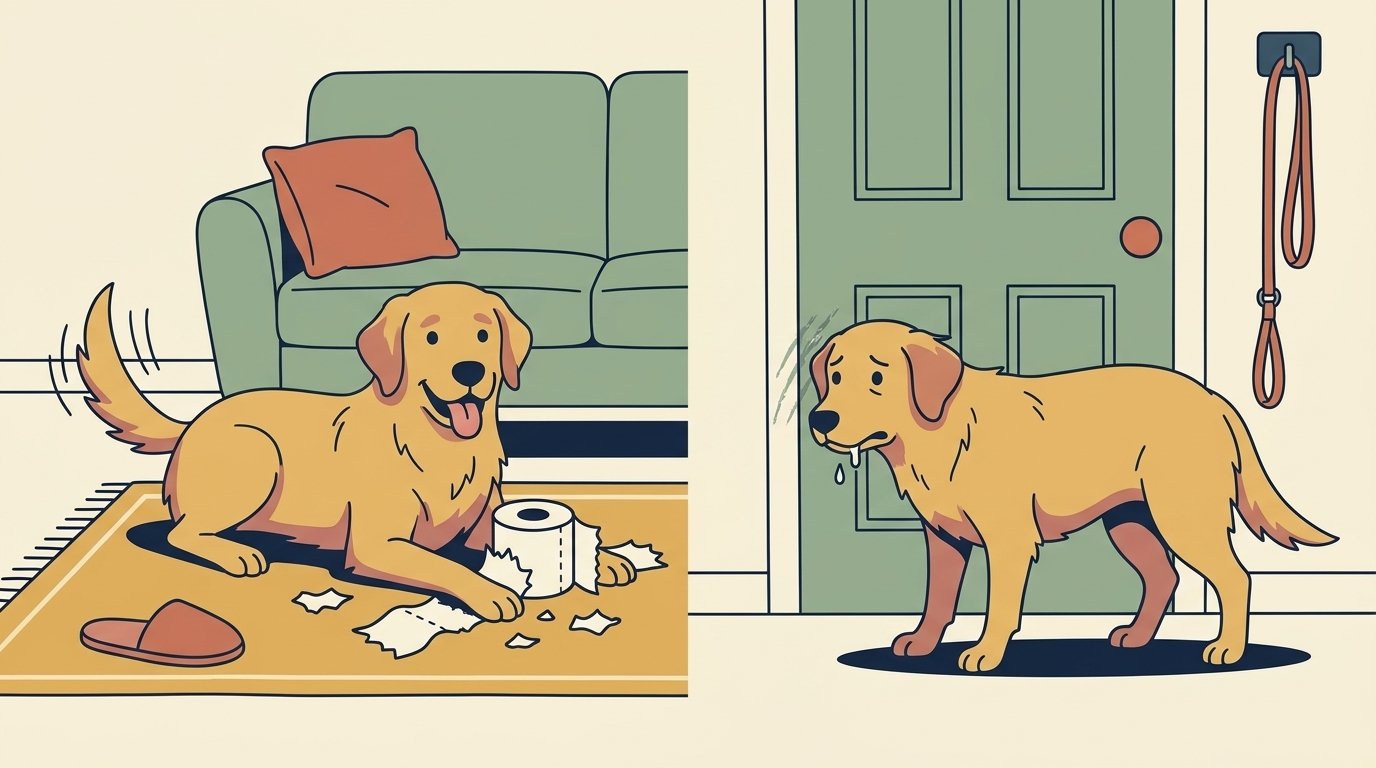
On one side: “I’m so bored, allow me find something to do.” On the other: “The sky is falling, and I have to escape and find you.”
Boredom: The “Let’s Find Some Fun” Manifestation
A bored dog is a fun-seeker. The destruction has logic, and it’s picky.
- Damage targets: Anything fun to shred, chew, or carry. Toilet paper rolls, slippers, remote controls, throw pillows. It’s about the texture, not the location.
- Timing: Your dog doesn’t start the moment you leave. Many dogs nap for two hours first, then wake up thinking, “Huh, I bet that couch comes apart.”
- Mood: Relaxed, even a little smug. Your dog plays with the toys you left and eats treats like normal.
- When you get home: Happy tail wagging, and an innocent face in the middle of a crime scene.
A quick myth-buster: that “guilty look”? Research suggests dogs are mostly reading your face and body language, not actually feeling remorse. So don’t pass judgment based on that expression.
The fix for boredom is simple: more exercise, more sniffing and puzzle toys, and slippers locked in the closet. Your dog isn’t bad. Your dog is a smart employee with nothing to do.
Separation Anxiety: A Full-Blown Canine Panic Attack
Dog separation anxiety isn’t “I miss you a little.” It’s a panic attack.
Your dog isn’t misbehaving. The body is sounding every alarm it has, and your dog can’t switch it off.
- Destruction at exits: Frantically digging at the front door, chewing window frames, gnawing door trim. The goal isn’t fun. It’s “break out and find you.” Some dogs wear down their nails or injure their gums, and the damage can be serious.
- Heavy drooling and panting: Puddles of drool on the floor or soaked patches by the door are a red flag.
- Refusing food: A dog who’d do a backflip for a piece of chicken ignores the treats you left behind. This is one of the strongest clues, because panic shuts the appetite right off.
- Accidents indoors: In spots a fully house-trained adult dog would never use. Don’t scold. Ask yourself whether your dog was too scared to hold it.
- Nonstop vocalizing: Not a couple of barks. Long stretches of howling, whining, and frantic barking.
If this list sounds familiar, take “teach them a lesson” off the table. Your dog needs help, not punishment.
For a second look at the warning signs, the ASPCA’s separation anxiety guide covers escape attempts, destructive chewing, and indoor accidents.
The Truth Machine: Why You Need a Pet Camera
Time for some no-BS advice. Stop guessing. You’re not there, so every conclusion is a guess.
The fix is easy: set up a pet camera. A dedicated one works. So does an old phone running a video app.
Focus on the first 15 to 30 minutes after you walk out the door, because dog separation anxiety symptoms are usually at their worst in that window.
- Pacing, howling, glued to the front door? Nine times out of ten, that’s separation anxiety.
- Two laps around the room, a big sigh, then straight to sleep? That’s most likely boredom.
- Naps first, starts wrecking things after waking up? Also boredom.
Fair warning: watching the first replay might break your heart. That’s normal. Save the footage. Your vet or trainer will find it extremely useful.
The RTO Shockwave: Why Modern Dogs Are Having a Mental Health Crisis
Behavior doesn’t happen in a vacuum. To understand your dog, you have to look at the world your dog lives in. And over the past few years, that world got flipped upside down.
From WFH Bestie to RTO Reality Check
Think back to 2020. You worked from home, and your dog slept at your feet. You ate lunch together and took a break mid-meeting for a walk. Your dog was living the 24/7 companionship dream.
Then your company sent an email: three days a week in the office. Or five.
For you, it’s a commute problem. For your dog, it’s the rules of the world being rewritten overnight. Your dog doesn’t have a calendar, doesn’t check Slack, and never got invited to the all-hands meeting. Yesterday you were home all day. Today the door closes and stays closed for eight hours.
- Pandemic puppies: For some dogs, “my person is gone” has never happened. They never learned the concept.
- Adult dogs who were already around: They got used to predictable company. When that rhythm breaks suddenly, the stress response blows up.
Your dog isn’t fragile. Your dog wasn’t prepared.
The Velvet Trap: Did We Foster Velcro-Dog Codependency?
Okay, now it’s the owners’ turn in the hot seat. Relax. I’m guilty too.
We dog parents love to hover. Your dog follows you into the bathroom, waits outside the shower, and when you’re chopping vegetables in the kitchen, it’s stuck to your calf like a fashion accessory. Dogs like this have a nickname: Velcro dogs.
That’s love, not a crime. But Velcro-style living has a side effect:
- Your dog has never practiced “you’re in another room, and I’m fine.”
- Your dog’s sense of safety is completely tied to “you’re within eyesight.”
Being alone is a skill, not something dogs are born knowing. Skills can be practiced, and you can always catch up. That’s the good news.
The 5-Step Blueprint: Rebuilding Loneliness as a Safe Space
This is the heart of the article: a 5-step plan for dog separation anxiety. Three ground rules first. Screenshot them and stick them on the fridge if you want:
- Practice in weeks, not days. Don’t rush. Seriously, don’t.
- Always train below your dog’s anxiety threshold. If your dog starts panting, drooling, or trembling, you pushed too fast; back up a step.
- Start with absences of a few seconds. A few seconds, then a few minutes, then slowly longer. Not eight hours dumped on them all at once.
Step 1: Desensitizing the Exit Cues (Killing the Magic of Keys)
Dogs are master observers. When you grab your keys, throw on a jacket, and put on your shoes, your dog’s stress level is already through the roof before you reach the door. To your dog, those actions are a countdown to “my person is disappearing.”
The practice is easy, and truthfully kind of fun:
- On days you’re staying home, pick up your keys on purpose, then sit back down on the couch.
- Put on your jacket and keep watching Netflix.
- Put on your shoes, walk a lap around the living room, then take them off.
- Repeat daily, mixed in at random, until your dog sees all this, rolls their eyes, and keeps napping.
The goal is to drain the magic out of these prompts. Keys are just keys.
Step 2: Setting Up the “Me-Time” Sanctuary
The key point: this is not about “locking your dog up.” It’s about building a special zone packed with positive associations.
- Pick an area: an exercise pen, a specific room, or a space blocked off with a baby gate.
- Put in your dog’s favorite bed and a water bowl.
- Prepare a few high-value toys that only appear when you leave. Put them away when you get home, so your dog thinks, “this toy = my person leaves = good things happen.”
One warning: Some dogs with true separation anxiety panic even more inside a crate, and might struggle hard enough to hurt themselves. Use your camera to confirm your dog is truly relaxed in that space. If your dog keeps throwing themselves against the walls, switch to a more open room.
Step 3: Draining the Battery with Mental Workout
Here’s the classic pre-departure move: run your dog for 40 minutes. The result? Adrenaline through the roof, and by the time you leave, your dog is still in turbo mode.
Try a different approach: tiring the brain works better than tiring the legs.
- Before you leave, play 15 minutes of scent work: hide treats in a rolled-up towel, a cardboard box, or around the living room and let your dog hunt for them.
- Or hand over a food-puzzle toy and let your dog work with nose and brain.
- Schedule physical exercise earlier in the day. Right before you leave, stick to “low intensity, high focus.”
Sniffing is intense mental work for a dog. After 15 minutes, expect yawns, then a slow walk back to the bed and a deep sleep.
Running out of scent-game ideas? Adrienne Farricelli’s Brain Training for Dogs is an online program built around 21 mental games. Wondering if it’s worth your money? Here’s my review of Brain Training for Dogs. Affiliate disclosure: If you buy through my link, I may earn a small commission at no extra cost to you.
Step 4: The Art of High-Value Distraction
Right as you’re about to step out the door, hand over a KONG toy stuffed with frozen peanut butter or wet food.
The point is to link “my person leaving” with “holy cow, this stuff is amazing.” Eventually, when you pick up your keys, your dog thinks, “Yes! Snack time.”
- Fill it the night before and stash it in the freezer. Frozen stuffing lasts longer.
- Always check the peanut butter label. Xylitol is highly toxic to dogs. If it’s on the label, don’t use it.
- Hand it over right as you leave, not hours earlier.
- If your dog won’t touch it, don’t force it. That’s the “refusing food” red flag from earlier. Make a mental note, because it comes up again later.
Step 5: Master the Cold Goodbye and Low-Key Return
Behaviorists keep repeating this golden rule: make leaving and coming home a nonevent.
Before you leave, skip the soap opera:
- Don’t crouch down for a 30-second hug or say “Mommy loves you so much, Mommy’s so sorry.”
- Make it light with a quick “bye,” or say nothing and go.
When you get home, even if your dog charges at you like they just hit the jackpot:
- Set down your bag, take off your shoes, pour a glass of water.
- Ignore your dog for about 5 minutes. Wait until all four paws are on the floor and your dog has calmed down, then say hello calmly.
You’re not being cold. You’re sending a message: your comings and goings are totally ordinary, nothing to panic about. Ordinary is the best kind of security.
The Brutally Honest Diagnostic Cheat Sheet
Scroll fast on your phone, or screenshot it and save it for later.
| Behavior Indicator | Simple Boredom | Separation Anxiety |
| Damage targets | Fun-to-shred stuff: toilet paper, slippers, throw pillows | Exits: front door, window frames, door trim, pen walls |
| Timing | Starts after a while, often after a nap | Within 5 to 30 minutes of leaving, sometimes the second the door shuts |
| Appetite | Eats treats, plays with toys you left | Refuses food, ignores even favorite treats |
| Type of noise | A few barks now and then, or barely any | Nonstop howling, whining, frantic barking |
| Body signals | Relaxed, lazy | Panting, heavy drooling, constant pacing |
| Indoor accidents | Rare | Common, even in fully house-trained adults |
| When you get home | Normal happy greeting | Frantic, borderline hysterical welcome |
| Camera footage | Sleeping, playing, wandering around | Glued to the door, pacing back and forth |
This chart is a guide, not a diagnosis. Some dogs have both, so make the final call with camera footage and a professional.
When to Call the Pros: Behavioral Medication and Real Training
Weeks in and still no progress? Your dog is hurting themselves (bloody nails, broken teeth, slamming into doors)? Don’t tough it out.
Start with a vet visit to rule out medical causes. Urinary tract infections, pain, and cognitive decline in senior dogs can all cause behavior that looks a lot like dog separation anxiety.
Medication Is Not Cheating: Navigating Behavioral Drugs
In the US and Canada, prescribing anti-anxiety medication for dogs with severe anxiety is very common. Fluoxetine (the generic name for Prozac) and clomipramine are commonly used long-term by veterinary behaviorists, while gabapentin is often used as short-term help for situational anxiety.
The biggest misunderstanding: “Meds = a zombie dog.” Nope.
The goal of medication is to lower the anxiety threshold so training can actually get into your dog’s brain. A dog in the middle of a panic attack can’t learn anything, the same way nobody can ask you to finish a spreadsheet in the middle of yours.
- A veterinarian must prescribe it.
- Some medications take a few weeks to show results, so be patient.
- Never give your dog human medication on your own.
Medication plus training is a package deal, not an either-or.
Finding a Bulletproof Behavior Consultant
The dog training industry has a low barrier to entry, and quality varies wildly. A few red flags. If you spot one, walk away:
- Promises of “fixed in three days” or “guaranteed cure”
- Use of a shock collar or any punishment-based tool
- Says things like “you have to show him who’s boss”
Adding fear to a dog who’s already panicking is pouring gasoline on a fire. Turn around and leave.
What you want:
- A consultant certified by the IAABC (International Association of Animal Behavior Consultants)
- A positive-reinforcement trainer with CPDT-KA certification
- For more severe cases, a veterinary behaviorist
Not sure where to look? The IAABC consultant directory lets you search for certified consultants by country.
In the interview, ask directly: “What methods do you use?” A good answer includes gradual desensitization, positive reinforcement, and video and records to track progress.
The Hard Truth: It’s a Marathon, Not a 100-Meter Sprint
One last piece of real talk.
Treating dog separation anxiety is psychological reconstruction. The progress curve won’t be pretty—the typical script: three steps forward, two steps back.
One day your dog makes it two hours, and you want to pop confetti. The next day, back to crying at the door. That’s normal. It’s completely fine.
Zoom out. Look back in a month or two, and you’ll see the whole curve trending up.
Instead of blaming your dog, put your energy into building security one small step at a time. When you sit on the couch today, pick up your keys, and teach your dog that keys aren’t scary; you’re depositing your dog’s future.
You’re not raising a perfect dog. You’re helping your dog learn one thing: you leave, but you always come back.
Your turn: What’s the most dramatic face your dog has made when they realized you were leaving? Share it in the comments. We’ll laugh with you, and wince with you too.
FAQ: Quick Answers for Worried Dog Parents
How Long Does It Take to Fix Separation Anxiety?
There’s no standard answer. A mild case can improve within a few weeks. Severe cases often take several months.
Plenty of variables affect the speed: how severe the anxiety is, how many times a week you can practice, your dog’s history, and whether life forces you to leave your dog home alone for eight hours a day. Progress isn’t a straight line, so don’t judge the whole thing by one week’s performance.
Can I Leave My Dog Home Alone for 8 Hours?
Depends on the dog.
A healthy, trained adult dog with no separation anxiety can often make it through a workday. Puppies, senior dogs, and dogs working through separation anxiety? No.
If your dog falls into that second group and your schedule is locked in, don’t just tough it out. Find ways to share the load:
- Hire a dog walker, or ask a neighbor or friend to stop by at midday.
- Consider doggy daycare (some anxious dogs don’t love it there either, so try a half day first)
- Talk to your employer about a hybrid or flexible schedule.
- During training, keep alone time as short as you can
Will Getting a Second Dog Fix It?
Usually not.
A dog with separation anxiety is typically anxious about a specific person, not about “having no dog around.” Adding a second dog often gets you two dogs crying at the door, or a new dog who picks up the anxiety too.
Don’t treat “dog number two” as the solution, unless you wanted another dog anyway.
Should I Crate My Dog When I Leave?
Depends on the dog.
A well crate-trained dog who sees the crate as a safe little den is fine. But a dog with true separation anxiety may panic even more when confined, and can wreck the crate or hurt their gums and paws.
Check with your camera. If your dog is relaxed and sleeping inside, carry on. If your dog is throwing themselves against the walls, switch to a more open space and ask a professional to help you assess.
Do Calming Aids Like Pheromone Diffusers or Thundershirts Work?
The evidence is mixed. Some dogs get a little help, and some don’t respond at all.
Treat these tools as supporting actors alongside the 5-step training above. Don’t expect them to solve the problem alone. If your dog has severe separation anxiety, these tools aren’t strong enough, so head back to the vet section.
Is It Okay to Yell When I Come Home to a Mess?
No, and it doesn’t work.
Dogs can’t connect your anger right now with something that happened hours ago. Your dog learns “my person coming home = trouble,” and gets even more anxious the next time you leave.
Take a deep breath, clean up, and treat the mess as data: What did your dog destroy? Where? Those clues are the raw material for the Cheat Sheet above.
Can Adult Dogs Suddenly Develop Separation Anxiety?
Yes.
Common triggers include moving, household changes, a big schedule change (yes, RTO), or an owner who was home all the time suddenly starting to leave every day.
When a senior dog suddenly shows anxious behavior, also consider cognitive decline. Any sudden, sharp change in behavior? The first step is always a vet visit.