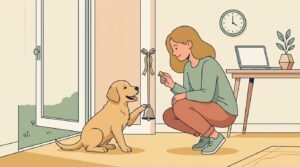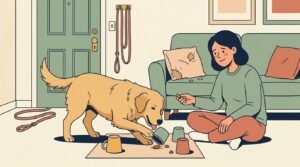
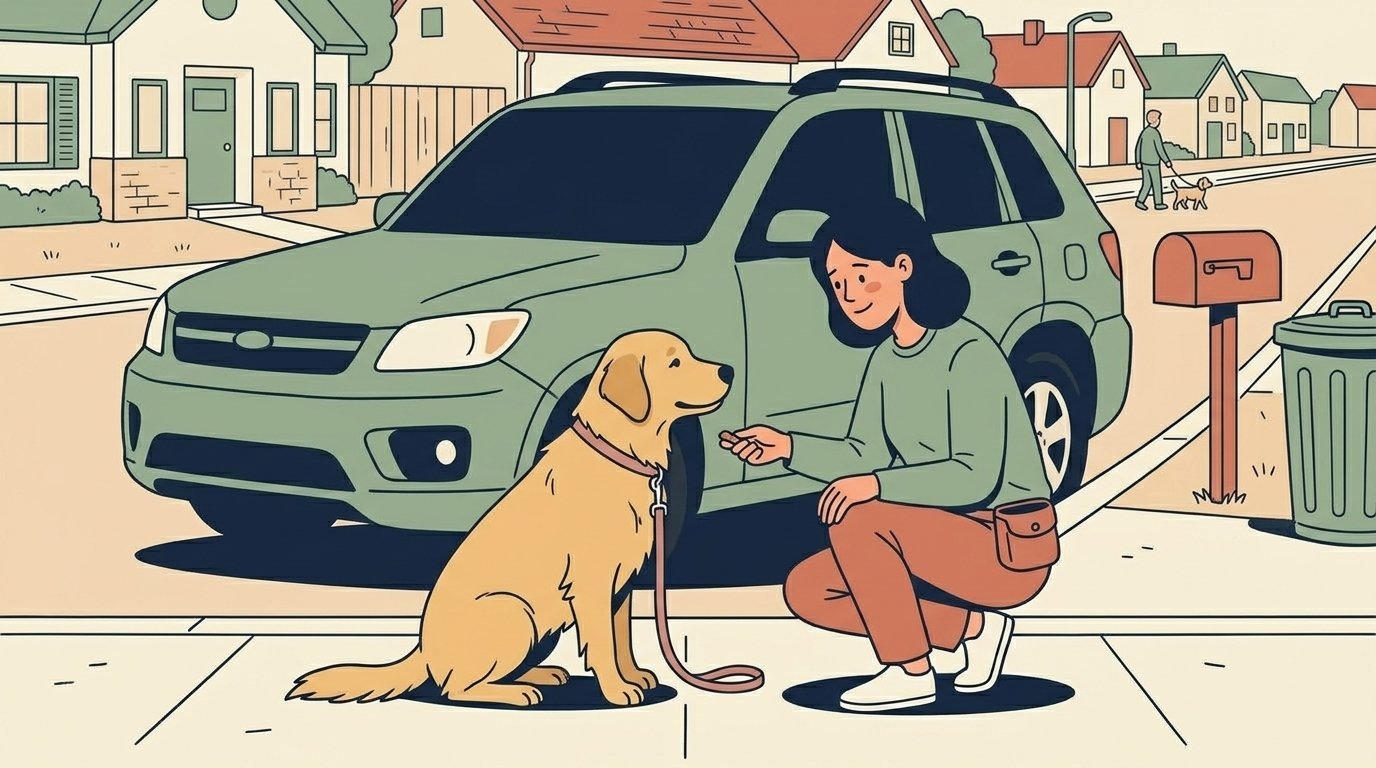
It’s 6 p.m. You just got off work, and you’re walking your dog around the neighborhood.
You turn the corner. Your neighbor is coming the other way with his dog. In half a second, your dog turns into Godzilla. Barking. Lunging. Front paws off the ground. You’re hanging onto the leash with both hands, forcing an embarrassed smile and saying, “My dog never like this!”
If you work a 9-to-5, you know this moment. Many owners start shortening walks or sneaking out at 10 p.m. to avoid it.
Trainers have a name for this: Leash Reactivity. It’s not your fault, and your dog isn’t “bad.” It’s fixable.
This guide gives you a full plan and insight. What to do outside. How to bail out in an emergency. And the piece most people skip: what happens inside your house.
Table of Contents
Decode the Drama: What Exactly Is Leash Reactivity?
Here’s the plain-English definition: your dog barks, lunges, or pulls hard on leash at a specific trigger, like another dog, a person, a skateboard, or a squirrel.
Here’s a quick self-check:
- Off leash at the dog park, your dog is sociable and even loves to play.
- The second the leash clips on, they lose it.
If both are true, you’re almost certainly dealing with classic leash reactivity. The problem isn’t your dog’s “personality.” The problem is the leash itself.
Let’s Kill a Harmful Myth First
You’ll see it on Reddit all the time: “Your dog is trying to be the Alpha. Dominate him. Show him who’s boss.”
Alpha dominance theory has been abandoned by behavior science. The American Veterinary Society of Animal Behavior (AVSAB) has a published position statement on dominance theory, and it recommends reward-based training only. Your dog isn’t fighting you for status. They’re dealing with an emotion—fear or frustration.
So please stop doing these things:
- Yanking or jerking the leash
- Pinning your dog to the ground
- Yelling at your dog
- Using choke or prong collars to “correct” them
All of these teach your dog one thing: other dogs show up, my neck hurts. Next time, the reaction gets worse. You’re not teaching calm. You’re teaching them that other dogs predict bad things.
The Psychology of the Lunging Dog: Why Is This Happening?
Two main emotions drive the lunging and barking.
1. Fear (Fight or Flight)
A wild dog who feels threatened can walk away. A leash removes that option. Your dog can’t back up or escape, so they pick the only choice left: the best defense is a good offense.
Barking, lunging, and showing teeth all have one goal: make the other dog go away. And it usually works. The other dog moves on, and your dog learns, “See? Barking works.”
2. Frustration (The Frustrated Greeter)
Trainers call this type the Frustrated Greeter.
This dog loves other dogs. They want to run over, sniff, and play. The leash says no. All that desire turns toward frustration, and frustration turns into a meltdown.
Here’s a rough way to tell them apart:
- Fearful dog: body leans back or freezes, tail tucked or stiff, bark sounds sharp.
- Frustrated dog: body leans forward, wiggling and spinning, bark sounds excited and rapid.
The training approach is similar for both. But knowing which one you have makes it easier to stay patient.
Trigger Stacking
This is one of the most important ideas in this whole article.
Stress adds up. Picture your dog’s tolerance as a bucket:
- You rushed out this morning and skipped a proper potty break (one drop)
- The delivery guy rang the doorbell while your dog was home alone (one drop)
- On the evening walk, they spot a squirrel (one drop)
- Then they see a dog down the street (the bucket overflows)
That last trigger alone doesn’t seem like a big deal. But your dog didn’t snap because of that one dog. They snapped because the whole day piled up, and that was the moment it spilled over.
That’s why the same dog can ignore another dog on Tuesday and explode on Thursday.
The “Safe Zone” Formula: Finding Your Dog’s True Threshold
Threshold is the core concept of leash reactivity training.
It means the distance at which your dog can see the trigger but hasn’t lost control yet. It’s different for every dog, and it changes day to day. Some days it’s 150 feet. Some days it’s 30 feet.
Use this table to check where your dog is right now:
| Zone | Status | What You’ll See | What You Should Do |
|---|---|---|---|
| 🟢 Green (Below Threshold) | Sees the trigger, can still think | Responds to their name, takes treats, loose body, soft mouth | Train here. Only here. |
| 🟡 Yellow (At Threshold) | On the edge | Stiff body, ears forward, tail high, hard stare, hesitates on treats | Add distance right away. Get back to green. |
| 🔴 Red (Above Threshold) | Brain has checked out | Frantic barking, lunging, can’t hear you, refuses treats | Emergency exit. Done training for today. |
One rule matters most: all effective training happens in the green zone.
Once your dog is in the red zone, nothing you say and no treat you hold will get through. The learning part of their brain is offline. You have one job: get them out of there.
The easiest test is this: will your dog still take a treat? If not, you’re too close.
Rewire the Brain: The Game-Changing Protocol for Leash Reactivity
The method North American behavior professionals recommend most is the Engage-Disengage Game (also called Look at That).
The idea is simple. Your dog sees the trigger, then turns to look at you, and you reward right away. Over time, the feeling changes. “Danger!” or “I need to go say hi!” becomes “Oh, there’s a dog. Time to check in for my treat.”
This game depends heavily on marker timing. You have to mark and reward at the moment your dog notices the trigger or turns their head. Be a half-second late, and you teach something different.
If you haven’t learned the basic steps yet, read this first: A Complete Leash Training Guide: From Indoor Practice to Loose-Leash Walking. Get your marking and rewarding solid, then come back for the advanced tips below.
Here are debugging tips that usually come only with years of experience.
1. Why Does This Game Fail on Your Street?
Three silent killers:
Killer #1: The Wrong Treats
Dry training biscuits work fine in your living room. Outside, with squirrels, strange dogs, and a thousand smells, they’re basically air.
You need what I call “biological weapons”:
- Baked chicken breast (nail-sized pieces)
- Hot dog pieces
- Cheese cubes
- Cooked ground beef
The rule: the treat has to be worth more than the distraction. The bigger the trigger, the better the treat.
Killer #2: Leash Tension
This is the one most owners miss.
A tight leash triggers the Opposition Reflex. You pull back, and your dog instinctively pushes forward. Worse, a tight leash carries your nerves straight down the line to your dog. When you tense up and shorten the leash, they think, “Uh-oh, something’s wrong.”
The fix: keep a loose J-shaped curve in the leash. Relax your arm. If you need to, anchor your hand against your stomach. Your body language should say “boring,” not “battle stations.”
Killer #3: Raising the Difficulty Too Fast
It worked in an empty parking lot yesterday, so today you try the park entrance. That’s a setup for failure.
Think of it like climbing stairs. Start far away with low distractions. After three to five wins in a row, close the distance just a little.
2. Advanced Tactic: Use Your Surroundings for Visual Blocking
In American suburbs and around city apartment buildings, there’s cover everywhere. Use it to break eye contact between your dog and the trigger.
Things you can use:
- Parked SUVs and pickup trucks
- Big trash and recycling bins
- Bushes and fences
- Cluster mailboxes
- The corner of a building
Here’s how: when you spot a dog ahead, don’t tough it out. Walk your dog behind an SUV right away. The vehicle blocks the line of sight, and your dog’s stress drops. Drop treats and play the game from there. When the other dog has passed, step back out.
Cut the line of sight, and your dog’s threshold shrinks. At the same distance, a dog with cover can handle a lot more than a dog out in the open.
3. The Ultimate Goal: From “Dog Equals Treat” to Real Relaxation
Most people stop at stage two: dog sees the trigger, looks at you, eats a treat. That’s good. It’s not enough.
The real goal is a body that is actually relaxed when they see another dog.
How do you catch that moment? Watch for these signals:
- A big exhale (a sigh)
- Weight shifting backward, almost sitting back
- Shoulders dropping, mouth soft
- Turning away on their own to sniff the grass
These are proof your dog is saying, “I’m okay.” Mark and reward right then. You’re no longer paying for the head turn. You’re paying for the calm emotional state.
That’s what this whole protocol is really rewriting.
Emergency Survival Skill: The Art of the Quick U-Turn
Even with solid training, you’ll get ambushed. An off-leash dog pops out of an alley. Two dogs appear at the same time.
That’s when you need a Quick U-Turn.
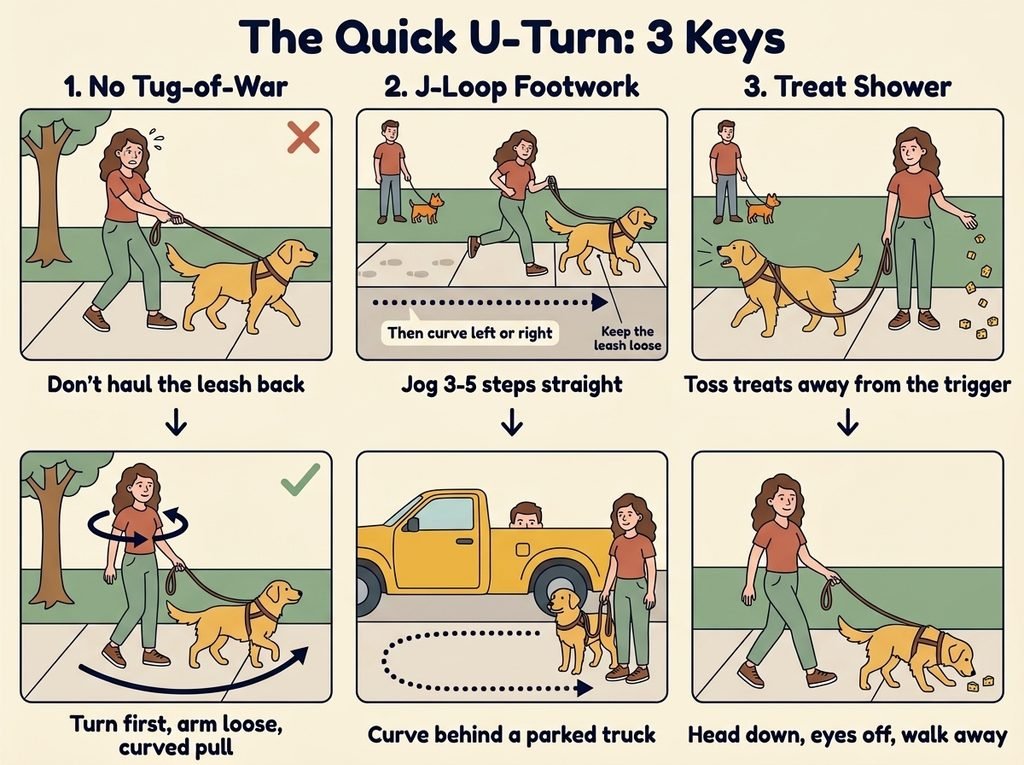
1. Why Do 90% of Owners Fail at the U-Turn?
Because they play The Tug War.
Here’s the typical scene: owner panics, spins around, and hauls the leash toward their body. The leash tightens around the neck. The Opposition Reflex kicks in, and the dog digs in and lunges forward instead.
The pro fix is lateral momentum.
Here’s how:
- Turn your body first. Don’t pull the leash first.
- Let your arm hang loose. Don’t reel the leash in.
- Use your body weight and turning momentum to create a sideways, curved pull.
- That curve physically breaks your dog’s forward balance, and they follow your turn.
You aren’t pulling your dog. You’re guiding them.
2. The J-Loop Footwork
Residential streets and alleys in the U.S. are often tight. If you spin in place, you turn your dog sideways right into the trigger.
Here’s the J-Loop:
- Jog 3 to 5 steps in a straight line (build distance and momentum first)
- Then curve left or right in an arc, like an upside-down J
- Use a parked vehicle (like a Ford F-150) to block the line of sight
The straight line gets your dog moving with you. The arc turns you away without pointing your dog face-to-face at the trigger. The truck is your cover.
3. The Treat Shower (Scatter Feed)
Don’t scream, shout, or babble while retreating.
Your volume and panic raise your dog’s arousal level. What they hear isn’t “let’s go.” It’s “Yep, this is a big deal!”
If you’re too close and your dog is already in the red zone, do this instead:
- Say your cue in a calm voice.
- Toss a big handful of cheese cubes on the ground in the opposite direction from the trigger.
- Your dog’s nose will instinctively drop to find the food.
That instinct to sniff the ground physically forces your dog’s head down and their eyes away. Once the stare breaks, the tension drops a notch. Use that window to walk them out.
The Hidden Root Cause: Why Outdoor Calmness Begins Inside Your House
Many owners train outside for weeks and get more frustrated each week.
The cause is often not outside at all.
When a dog goes through intense stress, cortisol (the stress hormone) can take up to 48 to 72 hours to fully clear. That means a blowup on Monday night can still affect your dog on Wednesday.
Now look at what life might be like at home:
- No consistent schedule. Meals, walks, and bedtime change every day.
- No crate training, so no deep daytime sleep.
- Not even a steady potty routine.
- Following you around the living room all day, always on alert.
That dog is already in hyper-vigilance while lying on your couch. Every doorbell, footstep, and shadow outside the window is another drop in the bucket.
Of course that dog blows up on the street. The bucket was already full.
If you want a calm dog with a loose leash outdoors, you have to build these things indoors first:
- A structured routine: set times for meals, walks, and rest
- Deep sleep in a crate or a set spot: adult dogs need a lot of rest
- A steady potty rhythm: so they know when it’s safe to relax
- Self-settling skills: a dog who doesn’t move every time you move
Stability inside the house is the foundation for calm outside it.
The Verdict: Reclaim Your Walks and Your Peace of Mind
If you’ve read this far, let me say one thing first: you are not a failed owner.
You came home from work and chose to spend your energy learning how to help your dog. That says a lot. Leash reactivity is common and exhausting, but it can get better. Not overnight. Step by step.
My conclusion is always the same: the outdoor skills are only half the job. The other half is in your living room.
Outside, here’s your job:
- Play the Engage-Disengage Game with high-value treats
- Use Visual Blocking to control distance at all times
- When ambushed, bail out with the J-Loop plus a Treat Shower
- Stay in the green zone. Always.
Inside, you need to build two foundations:
Foundation #1: A Steady Potty Routine and Schedule
A dog with no potty routine has to hold it all day and strain all night. Their stress bucket stays full. When the schedule is chaos, Trigger Stacking never stops.
If your dog is still working on potty training, or you can’t seem to lock in a routine, start with this review:
👉 Dog Potty Training in 7 Days Review: Can You Really Build a Routine in a Week?
In that review, I break down how the program works and tell you straight who it fits and who it doesn’t. For 9-to-5 workers, a consistent rhythm of eating, drinking, potty breaks, and rest is the first thing to fix.
Foundation #2: Brain Work and Self-Control
Many reactive dogs don’t have too much physical energy. They have too much unused brain energy. They sit at home all day with a bored brain, then pour everything into squirrels and strange dogs the moment they step outside.
The Engage-Disengage Game teaches your dog to think, wait, and listen even when excited. That’s Impulse Control, and you can train it indoors.
Here’s my review of a program built for exactly that:
👉 Brain Training for Dogs Review: Mental Workouts Instead of Pointless Walks
Ten to fifteen minutes of indoor brain training a day can use up part of your dog’s mental energy before you ever leave the house. It also teaches them to stay focused when you give a cue.
Which One Should You Start With?
| Your Dog’s Situation | Read This First |
|---|---|
| Unreliable potty habits, messy schedule, anxious during the day | Dog Potty Training in 7 Days Review |
| Potty and schedule are fine, but restless at home, poor impulse control, scattered focus | Brain Training for Dogs Review |
| Both are problems | Fix the routine first, then add brain training |
When your dog can finally relax at home, something changes. The next time that dog shows up at the corner, your hands stop shaking, and your dog stops turning into Godzilla.
That’s the first day you get your walks back.
FAQ: Leash Reactivity Questions, Answered
Can leash reactivity be cured completely?
Most dogs improve a lot, but “gone forever” isn’t a promise anyone can make. A realistic goal is this: fewer reactions, milder blowups, faster recovery. How fast you get there depends on your dog’s temperament, their history, and how consistently you practice.
How long until I see results?
Plan on several weeks to several months of steady practice. Some dogs show clear progress in two or three weeks. Others take longer. Don’t measure progress by “no barking at all.” Measure it by whether your dog’s threshold distance is getting shorter.
Is leash reactivity the same as aggression?
No. Reactivity is an over-the-top emotional response, usually meaning “go away” or “I want to get over there.” But left unaddressed, it can escalate. If your dog has ever bitten a person or another dog, see a qualified behavior consultant or veterinary behaviorist right away.
Should I let my dog greet other dogs on walks?
For a reactive dog, not for now. Greetings on leash are risky on their own. Two dogs tied to leashes can’t use normal body language. Build calm first. Work on socializing later.
My dog only reacts on leash and is fine off leash. Should I worry?
That’s the textbook pattern of leash reactivity. Don’t panic, but don’t ignore it either. The leash takes away your dog’s choices, so the goal is to train the emotion, not to “fix” their personality.
Can I use a muzzle?
Yes, and it’s a great safety tool. The key is to do positive muzzle conditioning with treats first so your dog connects the muzzle with good things. A muzzle isn’t punishment. It’s what lets you train with more confidence.
Harness or collar?
Go with a comfortable, well-fitted harness to avoid pressure on the neck when your dog pulls. Choke, shock, and prong collars link “seeing the trigger” with pain, and the reaction usually gets worse.
Disclosure: This article contains affiliate links. If you buy through them, I may earn a commission at no extra cost to you. I only recommend products I’d suggest to my own clients.