It’s 6:30 p.m. You just survived a full day of meetings, a commute, and traffic. Your jacket is still on, and your 60-pound dog is already spinning circles by the front door.
You clip on the leash. The door opens. Takeoff.
For the next 30 minutes, you aren’t walking your dog. Your dog is walking you. Your arm locks straight, your shoulder pitches forward, and your heels leave two skid marks on the sidewalk. You keep yelling “Slow down!” and praying there’s no squirrel ahead.
None of this is funny. Not for your body, anyway.
Pulling costs you both:
- Your dog: Neck, windpipe, and spine take repeated impact with every lunge.
- You: Sprained wrists, strained shoulders, and in bad cases, a dislocation. On a wet sidewalk or a downhill stretch, one hard yank can put you face-first on the pavement. Emergency rooms see this kind of fall more than you’d expect. One JAMA Surgery analysis of U.S. emergency room data.
Every piece of gear in the harness vs collar aisle claims to “stop pulling.” I’ve spent 10 years working with dogs, and I’ve watched countless owners buy their third harness and still go home with a sore wrist. So today there’s no marketing talk, just what works in the real world.
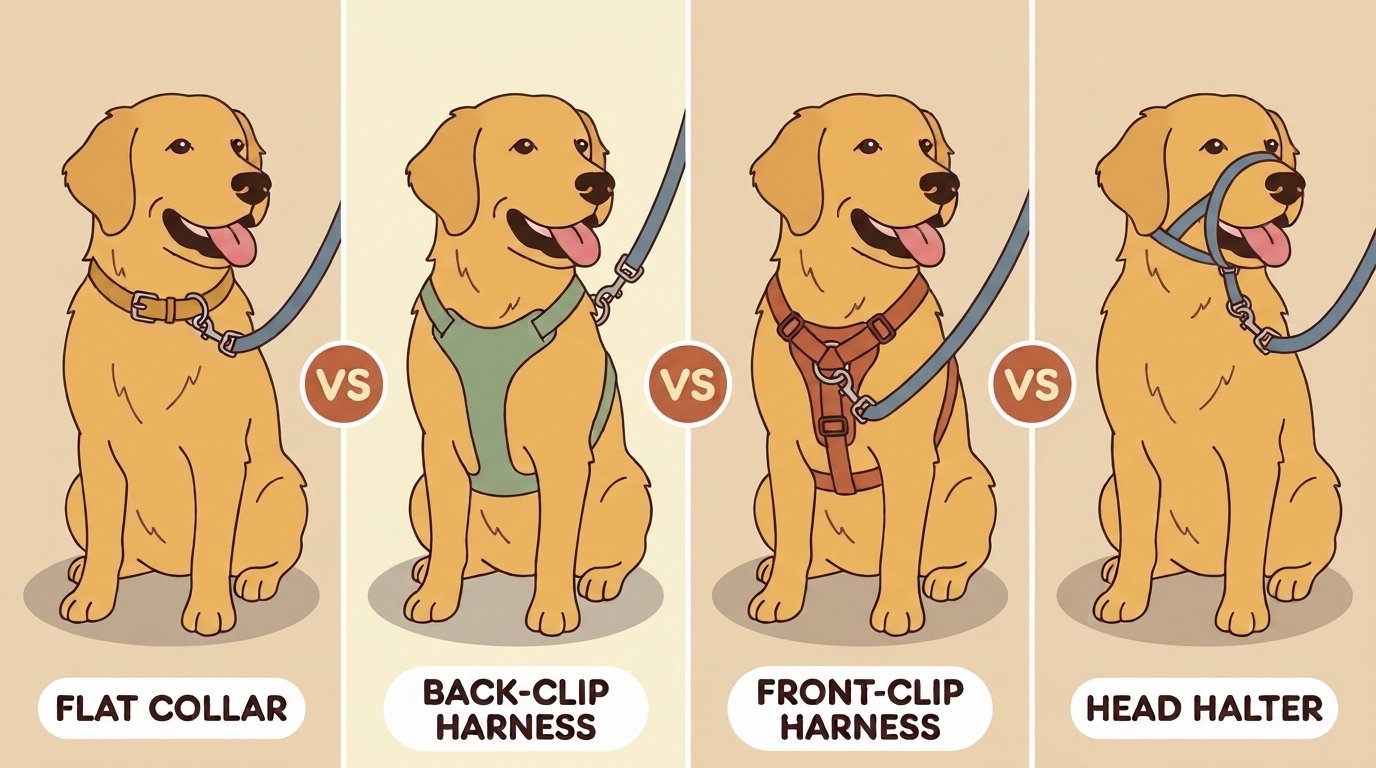
We’re stripping down the four most common options and testing them one by one:
- Standard collar
- Back-clip harness
- Front-clip harness
- Head halter
Here’s half the verdict up front: your wrist deserves better gear. The other half comes at the end of this article.
Table of Contents
The Standard Collar: Why Pulling Dogs Are Ruining Their Necks
What we’re testing: the standard flat collar.
A collar has one real job: holding the ID tag, license, and microchip info. That’s it.
The trouble starts when you clip a leash to it, and your dog is a puller. Now the collar is a windpipe killer. All the force lands on one small patch at the front of the neck, right where the trachea, esophagus, thyroid, and major blood vessels and nerves are packed together.
What it does to your dog:
- Repeated tightening can injure the trachea, trigger a dry cough, and cause throat irritation. Small dogs and breeds prone to tracheal collapse face a higher risk.
- A study in the Journal of the American Animal Hospital Association determined that pulling against a collar raises eye pressure, while a harness did not raise it significantly. For breeds already at risk for glaucoma, that’s no small thing.
- Long-term neck strain can cause pain, stiffness, and even nerve problems.
What it does to you: the Opposition Reflex
Dogs have a built-in nervous-system reflex: when pushed back, they push forward. Pushed sideways, they lean sideways. Your dog isn’t trying to defy you. It’s an automatic reaction.
So when the leash tightens against your dog’s neck, your dog doesn’t stop. Your dog pushes harder into it. Here’s what follows:
- The dog pulls harder and harder.
- All that force travels down one line and straight into your wrist and forearm.
- Your joints become the weakest part of the whole system.
Of all four options, this is the one most likely to strain your joints.
In the harness vs. collar debate, my bottom line is simple. If your dog doesn’t pull, a collar is fine. If your dog does pull, keep the collar for the ID tags and clip the leash somewhere else.
The Back-Clip Harness: The Secret “Sled Dog” Enhancer
What we’re testing: the traditional back-clip harness. The leash attaches on top of the dog’s back.
Credit where it’s due: it doesn’t choke the neck. From a physical safety standpoint, it beats a collar by a mile. If your dog doesn’t pull, or if you have a small dog, it’s a sensible, comfortable, easy-on, easy-off choice.
But you’re reading this because you want the pulling to stop. On that front, it does nothing.
Do you know where the pulling point sits on a sled dog’s harness?
On the back.
A back-clip harness spreads the load across the whole chest, so your dog can throw the big muscles in the chest, shoulders, and front legs into every step. In plain English: you just bought a sled dog training outfit.
- Your dog pulls with less effort.
- Your dog pulls for longer.
- Every time your dog drags you one more step, the lesson sinks in: pulling works.
It gets better at your end. Now that your dog can pull with its whole body, you’re the one most likely to get yanked off your feet and launched, especially in that half second when a squirrel or another dog shows up. You won’t even have time to react.
My bottom line: a back-clip harness makes a comfortable everyday piece of gear, but it is not an anti-pull tool. Don’t let the box slogan fool you.
The Front-Clip Harness: The Physics-Based Power Steering
What we’re testing: the front-clip, no-pull harness. The leash attaches at the dog’s chest.
This is the friendliest entry-level gear for your safety, and it’s best at keeping you from getting hurt. I’m putting that sentence first because it’s the core of this entire article.
The principle is physics, not magic. It’s called leverage.
When your dog surges forward, the ring on the chest sits ahead of the dog’s center of gravity. The pull turns the dog’s body back toward you. Your dog can’t send all its power in one direction. What used to be a straight-line tug-of-war becomes a slippery one.
Picture pushing a shopping cart with a stuck front wheel. The harder you push, the more it veers sideways. That’s your dog’s situation.
Here’s what that means for you:
- The sudden, violent yank spreads out and redirects.
- Your odds of a wrist or shoulder injury drop sharply.
- On a downhill, in the rain, or in a surprise situation, your feet are less likely to get ripped out from under you.
What to look for when you shop:
- Choose a Y-shaped design. The chest straps form a Y, sit on both sides of the breastbone, and don’t cross the shoulder blades.
- Avoid styles that cut across the front legs and shoulders. A strap sitting in front of the shoulder joint limits your dog’s front-leg stride and changes your dog’s gait. Your dog will be uncomfortable on every single walk.
- Fit it properly. You should be able to slip two fingers between the strap and your dog’s body. If it’s too loose, your dog backs out of it. If it’s too tight, it chafes the armpits.
- Leash length. A front clip can wrap the leash around the front legs. Use a standard 4- to 6-foot leash, not a retractable one.
My reminder: a front-clip harness is an excellent physical brake, not a behavior fix. It protects you. It doesn’t teach your dog how to walk.
The Head Halter: Power Steering for the 100-Pound Monsters
What we’re testing: the head halter (the Mild Leader type). The design works like a horse halter. One loop goes around the muzzle, and one goes behind the head.
It is not a muzzle. A properly fitted halter still lets your dog pant, drink, and take treats.
If your dog weighs 80 to 100 pounds and you weigh less than your dog, this is your ultimate physical brake.
The principle is simple: where the head goes, the body follows. You don’t have to wrestle a giant to control it. You gently guide the head toward you. For a dog that’s been trained to wear it, two fingers of pressure can steer the whole animal.
For owners with less strength, that’s a true rescue. It can fully protect you from getting dragged down the street.
But allow me to be straight with you:
1. This is not magic.
Most dogs get excited when you first put it on. They rub their faces on the carpet, paw at their noses, and roll on the ground. That’s a normal reaction. It doesn’t mean the gear is broken.
You need to spend at least one to two weeks on desensitization. Here’s the process:
- Set the halter on the floor. When your dog walks up and sniffs it, give a high-value treat.
- Hold the halter and put a treat on the far side of the nose loop. Let your dog choose to put its nose in to get it.
- Build up the time with the nose in the loop: 1 second, 2 seconds, 5 seconds. Treat every time.
- While the nose is in the loop, clip the neck strap, give a treat right away, and unclip right away.
- Slowly extend how long your dog wears it indoors, mixing in play and treats.
- Only take it outside when your dog wags its tail at the sight of the halter.
Never force it on. Forcing it creates a bad association, and your dog will run from it from then on. Every dollar and every hour you put in before that is wasted.
2. The rules of use.
- Never use it with a long line or a retractable leash. If your dog hits the end of the line, the head and neck can get yanked sideways. That’s a risk to the spine.
- Keep the leash loose and steady. Don’t let your dog slam into the end of it at full speed.
- Flat-faced breeds (like Bulldogs and Pugs) have a unique muzzle structure, and most styles fit them poorly. Check with a professional trainer or your vet first.
The Brutally Honest Gear Comparison Table
Scrolling on your phone? Here’s the quick version:
| Gear | Control (out of 5 stars) | Owner safety (sprains and falls) | Trainer’s pitfall: the fatal flaw | Best for |
| Flat Collar | ★★☆☆☆ | ★☆☆☆☆ All the force lands on the neck, and your wrist takes the hit | On a puller, it hurts the neck and triggers the opposition reflex | Dogs that already walk on a loose leash; holding ID tags |
| Back-Clip Harness | ★☆☆☆☆ | ★☆☆☆☆ Your dog’s full strength is in play, and you’re the easiest to pull over | Basically sled dog training. Your dog pulls harder over time | Non-pullers, small dogs, and anyone who wants quick on and off |
| Front-Clip Harness | ★★★★☆ | ★★★★☆ The pull gets redirected, and wrist and shoulder strain drops sharply | The wrong style blocks the shoulders and affects gait; the leash can tangle in the legs; it won’t fix pulling without training | Medium to large pullers; first-time buyers of anti-pull gear |
| Head Halter | ★★★★★ | ★★★★★ Two fingers can steer, a lifesaver for lighter owners | Needs 1 to 2 weeks of desensitization; hitting the end of the leash can twist the neck; not for flat-faced breeds | Giant dogs at 80 to 100 pounds; smaller, lighter owners |
Quick buying rules:
- First purchase, dog is 40 to 80 pounds → front-clip harness.
- Dog is over 80 pounds, and you don’t have the strength → use a head halter.
- Dog that pulls → don’t clip the leash to the collar or the back.
The Hard Truth: Tools Manage the Dog, Training Changes the Dog
Alright. Here comes the wake-up call.
In the training world, front-clip harnesses and head halters are called management tools.
They do two jobs:
- Physically, they keep you from getting hurt.
- For the dog, they keep the neck from getting choked.
That’s it. There is no third job.
No piece of gear can “cure” your dog’s pulling habit on its own. I mean any of them, including that pricey new model whose ad makes it look like a savior.
Think about why dogs pull in the first place.
First, because pulling works. No matter how tight the leash gets, if the dog is still moving forward, every step is a reward. The spot your dog wants to reach plus the smell your dog wants to sniff are all one pull away. Your dog isn’t bad. Your dog is smart.
Second, your dog’s brain is overstimulated. Before the door even opens, the heart rate is already up, and cortisol (the stress hormone) and adrenaline are climbing. A highly aroused dog is like a person who just downed five espressos. Try reasoning with that person, and not a single word gets through.
A dog that shoots out the door like a machine gun has a root cause that has nothing to do with the strap on its body. It’s in its brain.
So here’s the truth about gear:
- Change the gear, and the dog’s brain stays the same.
- Take the gear off, and the dog goes straight back to normal. That’s the definition of “management.”
- You can buy ten different harnesses and spend hundreds of dollars. Without training, you’ve just found a new way to get dragged down the street.
To keep a dog calm on a loose leash outside, the key is conditioning the brain and behavior, not where the leash clips on.
The Verdict: Reclaim the Lead and Invest in the Brain
Here’s my final word on harness vs collar vs head halter, plain and simple.
For your safety and your dog’s, go pick up gear now. A well-designed front-clip harness, or a head halter for a giant dog, is a solid choice. Treat it as the physical safety brake on every walk, so your wrists and shoulders stay out of the doctor’s office. You can do this step first.
But remember: gear only treats the symptom. Changing how your dog thinks is the cure.
Instead of throwing money at one “miracle” gadget after another, put your time and energy into your dog’s brain. You don’t need an hour of training a day. For a 9-to-5 worker, a few spare minutes are enough.
Want a structured way to do that? I put one popular program through its paces in Brain Training for Dogs Review: 21 Games—Is It Worth It?. And if house-training is part of the chaos at your place, I covered that too in Dog Potty Training in 7 Days: Reddit Debate & Honest Review.
Prefer to skip the reviews and go straight to the programs? Here are the direct links: Brain Training For Dogs by Adrienne Farricelli and Potty Training in 7 Days: The Accident-Free Method for Busy Owners.
Affiliate disclosure: The two program links above are affiliate links. If you buy through them, I may earn a commission at no extra cost to you.
A practical three-step plan:
- Practice loose-leash walking indoors, with no distractions: living room, hallway, 3 to 5 minutes at a time. Your dog walks beside you on a slack leash, and you treat right away. Two or three short rounds a day beat two hours on the weekend.
- Set up a clear reward system for walks. There’s only one rule: slack leash means you move forward and your dog gets rewarded; tight leash means you stop and stand like a tree. Your dog looks back at you, the leash goes slack, and only then do you continue. Every few steps, drop a treat by your leg so your dog learns that staying next to you is the best deal around.
- Add distractions slowly. Living room → front door → quiet street → park. Each time you level up, lower your standards first and reward more.
Want the full walkthrough? I broke it down step by step in Leash Training: 3 Steps to Stop Your Dog From Pulling. If your dog also lunges at other dogs or people, start with Leash Reactivity: 5 Proven Ways to Stop Lunging.
One more free trick: the front door is the starting line of training. If your dog is still jumping and barking, the door stays shut. Wait for a calm sit, then open it. You’ve just drained half of that excitement at the door, and the whole walk gets a lot easier.
Let your dog choose to stay by your side, instead of being forced to by the leash.
You keep the final say on your walk in your hand, not on that taut leash.
Quick FAQ
Q: My dog pulls hard. Which piece of gear should I switch to first?
A front-clip harness. It redirects the pull, protects your wrists and shoulders, and doesn’t choke your dog’s neck. If your dog is over 80 pounds and you don’t have the strength, consider a head halter next.
Q: Does a back-clip harness make my dog pull more?
For a dog that already pulls, yes. With the leash on the back, your dog can push forward with its whole body. Pulling gets easier, and you get easier to knock off your feet. For dogs that don’t pull, or for small dogs, it’s fine.
Q: Is a collar completely off limits?
No. Use it for ID tags and the license. But if your dog pulls, don’t clip the leash to the collar. All the force lands on the neck, so your dog’s windpipe and spine take the hit, and your wrist takes it worst of all.
Q: Can a head halter hurt my dog?
Not when it’s fitted and used right. Three key points: spend at least one to two weeks on desensitization, keep the leash loose and steady so your dog doesn’t hit the end of it, and never pair it with a retractable leash. For flat-faced breeds, have a professional check the fit first.
Q: If I switch to a front-clip harness or head halter, will my dog stop pulling?
No. Both are management tools. They only protect you and your dog’s neck. Take the gear off, and your dog goes right back to old habits. Changing the behavior takes training.
Q: Why does my dog pull the second we leave the house?
Two reasons. First, pulling works: the leash tightens, your dog still moves forward, and every step gets rewarded. Second, your dog is already wound up before you even leave. Gear can manage the force. It can’t manage the brain.
Q: I work 9 to 5 and don’t have time to train. What can I do?
Use scraps of time. Practice 3 to 5 minutes indoors 2 or 3 times a day. Before you leave, wait at the door until your dog sits calmly, then open it. On the walk, a slack leash means keep moving and give a treat. A tight leash means stop.